02 décembre, 2017

FEMINISM AND ACCESS TO HEALTH SERVICES: HOW A PROFESSIONAL ACTIVITY CONTINUES TO BE A STRUGGLE

This article has been presented within Symposium intiteled Modernization, Islam, (neo)Liberalism and reproductive Policies in Tunisia and Turkey, Practicing feminist medecine in the system that took place on November 13, 2017 in Geopolis Lausanne

Tunisia has been precocious compared to other Arab and Muslim countries when it comes to the emancipation of women. 
Long before independence, Ibn Abi Dhiaf, (1804- 1874), a Tunisian historian and politician, known to be the author of a multi-volume chronicle on the history of Tunisia And private secretary of five successive beys of Tunis ; wrote in 1856, his Epistle on Women, (Risalah fi al'mar'a), as a response to a list of 23 questions asked by Léon Roches, General consul of France in Tunis.
This thirty-pages manuscript examines the social role of women in Tunisia, their ights and duties with regard to the family and conjugal relations (marriage, divorce, polygamy, presence in the public sphere (veiling). isolation, segregation and repudiation), housework and lack of education.

Nearly in the same period, Minister Khair-Eddine, a major actor in the Tunisian reform movement, called for women’s education and the modernization of the political system based on the reconciliation of Western contributions with Islam.

Half a century after that, Tunisian activist Habiba Menchari called for veil abolition at a conference in Tunis in 1924 and publically removed her veil. Four years later, she was pleading for the abolition of polygamy, and from 1924 to 1929, public interventions by Habiba Menchari and feminist activist Manoubia Ouertani aroused scandal among conservatives.
In that same intellectual motion, Tahar Haddad, syndicalist and Tunisian author, raised the question of the Personal Status of Women in 1930 to the public opinion.
From 1930 to 1955, several newspapers published articles on women's dowry, polygamy, veil, education and voting rights.

There have been pioneering women's organizations in the colonial era like
Muslim Women's Union of Tunisia (1936-1956) made of committed women of the upper middle class anticolonialist activists like Bchira Ben Mrad  (1913-1993)- anticolonialist activist who created the Muslim Union of Women of Tunisia in 1936, linked to the Zeitounian circles, (visa in 1951 and dissolution in 1956).
Meanwhile, The Union of Tunisian Women U.M.F.T was created in 1944 after the victory of the French Left that favored the establishment of and was linked to the Tunisian Communist Party ; whose demands mainly concerned the schooling of young girls but which, under the Protectorate, turned into political demands for the victims of colonial repression.
This NGO focused mainly on the emancipation of women and the schooling of disadvantaged children, it’s activities were reduced after independence, until its dissolution, in 1963.

Since the independence of the country (1956), women's emancipation has been closely linked to nationalism, modernity and even universal access.
The Code of Personal Status had secular orientation, published in August 13, 1956 (before the constitution)  and it Abolished polygamy, replaced repudiation by the judicial divorce that the two spouses also have the possibility of claiming,  and abolished of the matrimonial guardian ; 
CSP gave also women the right to vote and eligibility in municipal elections.
In the years following independence, women got the right to work, to move, to open bank accounts or to set up businesses without requesting the permission of their husbands.
From the early 60s, a vigorous family planning policy was implemented making contraceptives available throughout the country   and legalizing unconditional abortion.

The emancipation dynamic, however, lost its impetuosity in the 1970s. At that time,The political will to break the Marxist intellectual left lead to the constitution of "Safeguarding the Quran" associations, first nuclei of what will be the Islamist movement.
And in 1973, a circular prohibiting the celebration and registration of marriages between Muslims and non-Muslims was published making all mixed marriages where the spouse has not converted to Islam null and void in the eyes of the Tunisian authorities.
Bourguiba renounced in 1974 to modify the inheritance law aiming gender’s equality and in the late 70s, a total stagnation of women's status took place since the improvement of women situation was no longer a main priority.
Nevertheless, in 1981 a law that automatically conferred to the mother the guardianship of minor children in case of the death or incapacity of the husband, and new measures in favor of women in case of divorce. During this period, the first research topics on women, especially in history and sociology in universities
Luckily previous social changes helped the emerge of feminine consciousness capable of rethinking the question of women and femininity; the Tunisian feminist movement was born during this period: the Autonomous Feminist Movement (1978 to 1982). The exacerbation of socio-economic contradictions generates a movement of opposition in the wake of which is born an autonomous feminist movement, marked by the creation in 1978 at Club Tahar Haddad, of the Club of the Condition of the Women, carried by a group of students of the Human Sciences  University of Tunis aiming the creation of a Women's Trade Union Commission.
Feminine members of the Teachers and Scientific Researchers Union created this commission on March 8th 1982, during an event, in the presence of Taieb Baccouche, general secretary of the UGTT who gave his approval for the creation of the Study Commission on the Status of Women at Work, within the UGTT.
This NGO could also have been created as a response to the National Union of Tunisian Women (1958-2012) created in January 1956 under the aegis of the Neo Destour, which first president was Radhia Haddad. This organization was never independent because it was always subordinated to the ruling parties under Bourguiba and Ben Ali. UNFT was charged with balancing effective participation of women in economic and social life with the promotion of a harmonious family life. This structure has always executed the programs of the ruling party and was a force of political mobilization.

The Autonomous Feminist Movement got more structured between 1978 and 1982 and the consolidation of the Movement took place in 1989 with the creation of two independent NGOs in opposition to the established power, namingly  AFTURD (Association of Tunisian Women for Research on Development) and the ATFD (Association of Democratic Women), who have contributed a lot to the promulgation of new laws for women, maintaining the pressure on the power in place from 1989 to 2011.

An importent event took place on November 7th, 1987, when Ben Ali took over power  and this was accompagned by new cultural practices as Interruption of television programs to transmit the daily five prayer calls but also Reopening of the former theological university of Zitouna suppressed shortly after independence by Bourguiba and Beginning of the glorification of "Arab-Islamic identity" of Tunisia by the new regime.
Surprisingly Official receptions had become exclusively masculine.
For the feminist movement, it was no longer a question of feminists claiming but of defending the CSP against attacks not only of Islamists, but also of the political party in power ;
Ben Ali publicly affirmed his attachment to the CSP in 1988, but nothing more. During 1989 election campaign, candidates of the ruling party tried to attract votes through an Islamic discourse.
But in 1990, following the conflict of the state with Islamists, the president reconnected with a state feminism without breaking up with the Arab-Muslim identity.
So in 1991, the Center for Research, Studies, Documentation and Information on Women (Credif) was founded  and a national commission "Woman and development » was established ; the President even announced the creation of a State Secretariat for Women and Family and Women got appointed to ministerial offices. In addition, in 1993 some changes are made on the CSP without responding to all the wishes of the feminist movement, who advocates for a clear recognition of gender equality, they are nonetheless not negligible and tend to change paternal authority towards shared parental authority between the two spouses and the consent of the mother becomes mandatory for the marriage of a minor girl. Legislative innovations were made since 1995 in the distribution of property within the couple following the demands of feminist activists and mechanism to facilitate donations during lifetime aiming to mitigate the effects girls' inequality in inheritance were studied.

The cause of the woman was used to promote the regime but the regime wan’t ready to grant the equality of inheritance under the pretext of respecting the Arab-Muslim identity

After the revolution, many events took place, the one with the most strong symbolism when it comes to women emancipation was that the two tombs of Tahar Haddad and Bourguiba were desecrated by Islamic extremists.

Several feminist NGOs were created, aiming for the fight for parity, women empowerment and insuring the mobilization of civil society whenever the ruling party seemed to be slipping.
These NGOs had a common struggle: the inclusion in the Constitution of the principle of total equality, the separation of politics and religion and the universal dimension of human rights and women's rights in particular so discussions about modifying the CSP impulsed strikes in 2014.

Feminist NGOs have been also active in lifting the reservations to the UN Convention on the Elimination of All Forms of Discrimination Against Women (CEDAW).

                  Since then feminist NGO worked on the eleboration of a law proposal against gender based violence that has been lately discussed in the national assembly.

After this overview of the history of feminism in Tunisia,it seems obvious that Machismo is a bias and it distorts history and science; since history is written by the strongest when it comes to civilizations, It is mostly written by men all the time which implies the constant minimization of the role of women;  Even in science, the veracity of purely scientific data is sometimes doubtful because, without being aware of it, the scientists having a machos bias, cannot stand feminine figures being more represented than masculine and tend to give explanations, create classifications… aiming the promotion of masculinity; like the famous story of the fastest, strongest spermatozoide that isn’t right at all since the ovocyte is the one who chooses the spermatozoide and aspire it
Sometimes we just have to stop and observe how much the patriarch can harm women by this self-destruction that he maintains; Oedipus kills his father and becomes his own father (Capitalisme et schizophrénie – Gilles Deleuze et Felix Gattari) ; it’s a destructive narcissistic dynamic that makes women often a collateral damage;

Things are quite the same when it comes to medical practice and more specifically in sexual and reproductive health services since services for women are always criminalized based on a religious approach ; not accessing health services is a violence
This is a truth in the general population; but the most affected people when it comes to unsatisfied health needs, are women belonging to vulnerable populations; they sum up being a woman and other specific barriers to each population.

Indeed, Women with Handicap do not access to the most basic human rights neither information since they lack autonomy and have a permanent need for assistance they cannot have confidentiality mainly within the absence of adapted services.
This group of women have a significant experience of violence and rape and at the same time they suffer a denied sexuality by society that is an unspoken non-right to sexuality and imposed infertility and / or maternity.

The second group are Migrant women that suffer Perceived barriers to health services due to Stigma and  Fear of being incarcerated if migrating illegally and Real barriers being Financial (no social security), Administrative (no identity document) or Non access to information and total ignorance of the health system and rights . Migrants do not access the same services as citizens in many countries.
Within this group, some are  also Victims of human trafficking which is a the modern slavery.

I think that there is a specific group that is the most affected by barriers to sexual and reproductive health services: Women drug users. Indeed, they suffer intense stigma. In addition,  there is a huge lack of adapted services in the public sector when it comes to drug use in general ; Nonetheless, there are some services offered by NGOs that are statistically insufficient in number for the general drug users popultaion and in gender approach due to lac of funds but also Punitive Law (article 52).
Many of those women sum up several risky behaviors  and some of them are victims of criminal organisation and human trafficking.

Nature hates the void, the planet needs a ground feminism to respond to the needs and services beyond which, these needs will be phagocyted by the patriarch since the lack of services makes verbalization of needs much easier to eliminate; while the provision creates an airway that acts as a protection for the services that exist and a basis to build on.
There is a necessity of a popular feminism approach that will be able to reach for all women from different social classes and backgrounds, in addition to the feminism carried out by the intellectuals;
Feminism should aim the empowering of women with little or no education and those belonging to vulnerable populations; it should step out its intellectual sphere and become easier to be adopted by all women regardless education, financial status…
That's what I would call Basic Feminism : a way to assert feminism in society, to protect women's achievements and to continue fighting for more.
Access to sexual and reproductive health services is an outcome, several factors intervene in the behavior of seeking care: culture, financial means, perceptions, morality ...
In order to have an impact, a holistic approach that integrates education, women's empowerment, financial independence must be though about.
A government should provide the services and  insure the protection of its citizens and stop playing moralizing father; the patriarch is weak, it tries to compensate for this impotence by giving itself the impression of controlling the intimate life of the citizens using absurd laws; Feminism have to set the record straight.


13 août, 2017

Réfugiée féministe


Bintou n'avait pas encore 18 ans quand sa mère est venue la voir, un après midi, alors que le soleil se couchait pour lui annoncer un grand événement; il fallait se préparer, Bintou allait se marier avec l'un des plus beaux et des plus riches jeunes hommes du village.

Bintou appartenait a une famille bourgeoise, elle a toujours été gâtée; née dans le berceau des traditions, elle a été éduquée au respect le plus absolu des règles sociales, elle était une jeune fille modèle, elle rayonnait innocence et obéissance pour le plus grand plaisir de ses parents.

Bintou a eu le plus exubérants des mariages, les invités affluaient des quatre coins du Sahara; les cadeaux, les rires, les chants, les danses...Ce festival du Grand Désert dura pendant une douzaine de jours ou les journées étaient chaudes et conviviales et les nuits fraîches et joviales.

Après quelques mois, Bintou explora les douleurs les plus atroces lors de son accouchement de son premier enfant; elle endura un passage brusque vers une vie d'adulte;
Ce premier enfant était attendu de la part de toute la tribu, ils attendaient impatiemment l'héritier de l'honneur familial;
A la place de donner vie aux attentes des chefs de la tribu, Bintou eu une petite fille toute fine et menue, une petite créature douce et fragile qui criait tout le temps et elle succomba aux caprices de cet ennemi juré de Morphé;

Aprés une semaine, le mari de Bintou entra doucement dans la chambre, il était grand de taille, avait des yeux pétillants et un sourire léger omniprésent. Bintou, qui n'a jamais su ce qu'est l'amour avant, avait toujours cette sensation exquise semblable à une brise qui parcoure sa peau fine à chaque fois que leurs yeux se croisaient; elle était amoureuse.

Ce matin, le grand si doux demanda à Bintou de prendre son bébé; Bintou lui donna la petite créature qui venait tout juste de s'assoupir; il l'a prise dans ses bras, embrassa son front et sorti en l'emmenant sans dire mot.
Bintou sentit son cœur s'arrêter de battre, elle ne comprenait pas; ce sentiment de danger imminent et inexpliqué.

Quelques heures plutart le grand aux yeux doux revint mais son regard n'était plus le même, quelque chose semblait s'être éteinte au plus profond de son âme.
Il redonna la petite chose à Bintou; l'enfant avait le visage vultueux, les draps étaient rouges sang;
Bintou le regarda la peur au ventre;
"Il fallait le faire" dit-il "Maintenant, les chefs sont satisfaits";

Le petit hominidé a subit une opération chirurgicale; il fallait lui couper les petites lévres et le clitoris; sinon elle grandirait dans la honte et la débauche.

Bintou avait elle aussi subit cette opération, elle avait l'impression d'avoir oublié cette horreur; elle revivait sa douleur à travers son enfant et sa souffrance était juste exponentielle.

Comment son bien aimé, ce doux aux yeux pétillants, as-t-il pu permettre cette abomination; pire, y adhérer, y participer;
Lors de leurs premières nuits ensembles, Bintou lui avait ouvert son cœur et lui avait décrit la monstruosité de ce qu'elle avait subit enfant;
Il avait même pleuré;
C'était incompréhensible, injuste et méchant.

Bintou, en bonne épouse et en bonne fille d'honorable chef de tribu a avalé sa douleur dans le plus grand des silences et a essayé de faire comme si cette journée n'avait jamais existé.

Quelques mois plutart, Bintou était encore enceinte; les chefs de la tribu se réjouissaient à l'idée d'avoir finalement un héritier mais Bintou était effrayée.

L'accouchement se déroula normalement; encore une petite créature menue, encore une petite fille fragile...
Le grand aux yeux doux n'osait plus regarder Bintou dans les yeux.
Il n'avait rien dit, il avait embrassé sur le front le nouveau né;

Personne ne pourra décrire la violence de la tornade qui a éclaté à ce moment précis dans la tête de Bintou; une rage inégalée lui colonisait le corps;
Elle était décidée, elle le fera, elle le fit, elle est partie.

J'ai rencontré Bintou aux urgences d'un hôpital dans la zone parisienne;
Elle a tout laissé derrière elle, argent, famille et honneur;
Elle était là, une nuit d’août, seule avec les deux petites ennemies de Morphé.

Elle a entrepris les plus dangereux des voyages pour sauver sa fille; elle ne voulait pas qu'une autre femme subisse ce supplice.

Bintou n'est pas réfugiée politique, elle n'est pas migrante économique, elle est juste humaine;
Elle a fait sa révolution, douce et silencieuse mais si forte et pleine de sens.

Les femmes comme Bintou ne bénéficient d'aucune convention, l'humanité ne leur accorde aucune grâce.


27 juin, 2016

L'histoire d'un nébulisateur


Certains livres comme Where There Is No Doctor, sont supposés préparer les jeunes médecins à des réalités de terrain autres.

J'ai appris la médecine au sein des hôpitaux de la Tunisie. Nous n'avions pas toutes les technologies à disposition mais le niveau de formation était élevé et l'enseignement de qualité.

A la fin de mon cursus, j'ai décidé de virer de bord, ne pas prendre le chemin qui mène vers une vie confortable de médecin consultant bien installé dans son cabinet mais d'aller voir d'autres contextes, partir en aventure, découvrir l'humain et la médecine...

Ainsi, je suis partie au Niger, l'un des pays les plus pauvres du continent africain malgré des ressources immenses en Uranium dont le pays ne peut jouir à cause d'une politique post coloniale des plus abracadabrantes...

Travailler dans l'humanitaire nous met face à des situations complexes auxquelles nous devons répondre comme médecins dans le respect de l'éthique et de la déontologie;

Pour ainsi dire, il s'agit d'une suite de situations critiques où  la mort fait partie du quotidien, où la faim n'est pas une sensation mais une maladie.

Venant d'un contexte arabo-africain, d'un pays en voie de développement, j'étais supposée m'adapter rapidement à cette réalité mais ce ne fût pas aussi évident:  je n'avais jamais vu un enfant mourir de faim; le kwashirkor et le marasme étaient une pure théorie: des cours anecdotiques, une sorte de folklore qu'on avait étudié à la faculté sans y porter grand intêret.

La mort était pour moi une complication évitable faisant suite à une pathologie et non une évidence...
Quand on part ailleurs, tout est remis en question, pratiques,  certitudes, habitudes, façon de voir et de sentir et même réactions;

A l'évidence, quand on revient, on n'est plus la même personne.

Sur place, on use  d'initiative de ténacité mais surtout de créativité pour faire face à la cruauté d'une réalité qui nous dépasse.

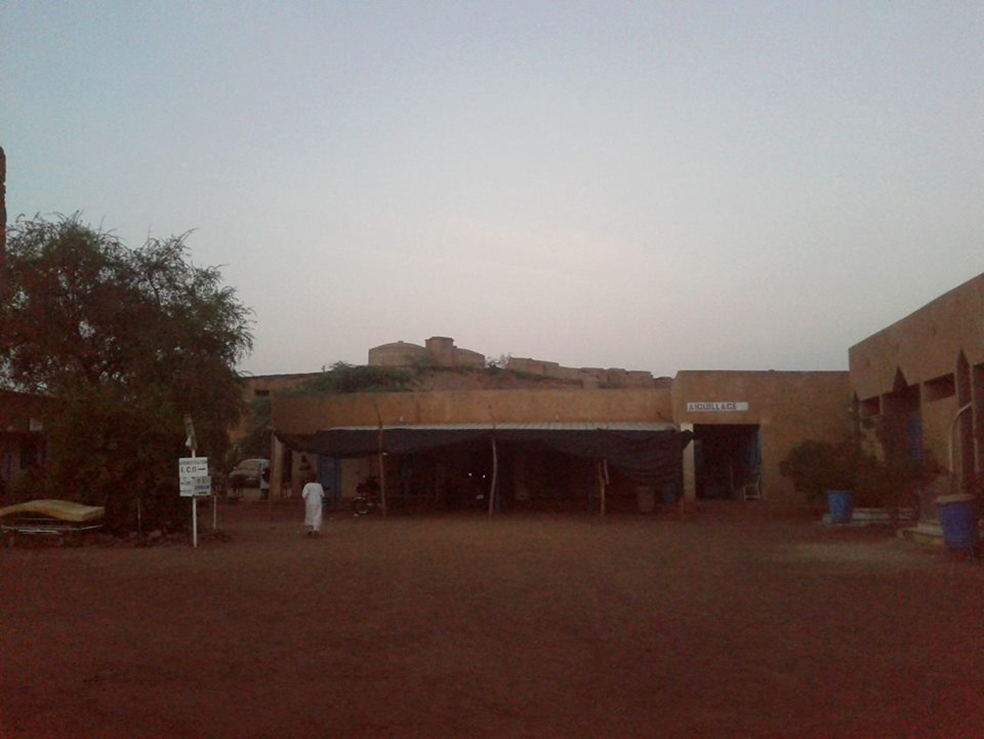
J'ai travaillé comme médecin dans un hôpital en plein brousse à Bouza, un village à prés de 600 Km de Niamey, capitale du Niger.


Il s'agissait d'un hôpital pédiatrique avec un service de néonatologie mais surtout avec des moyens très limités.


Une panoplie de pathologies des plus compliquées et la responsabilité vis à vis de la population locale qui nous voyait comme des sauveurs nous stimulaient.
Il fallait sauver des vies; une dance lugubre avec Lucifére se réitérait chaque jour...

Il y avait une fréquence élevée d'atteintes respiratoire chez les enfants et surtout les nourrissons qui développaient beaucoup de bronchiolites.

Entre autres, il n'y avait pas de nébulisateur au sein de la structure sanitaire et dans les environs.

Suite à cette observation, il fallait trouver une solution.

Il n'y a pas de probléme, il n'y a que des solutions: un nébulisateur a été donc créé avec les moyens du bord.

Fabrication:

Ce dont on a besoin: un exctracteur d'oxygéne, une tubulure d'oxygéne, un masque à oxygéne pédiatrique, une boite de médicaments vide et nettoyée en caoutchouc.

Il faut faire deux trous sur la surface plane de la boite en respectant le diamétre de la tubulure et du masque à oxygéne; insérer les deux  bouts via les deux trous en s'assurant de l'étanchiété.

Le bout de la tubulure doit être incurvé au fond de la boite pour éviter tout blocage.

Fonctionnement:

Le débit d'oxygéne utilisé doit être maximal: 8L O2/ min.

La quantité de liquide utilisée doit être supérieure à 5 cc (la quantité de liquide utilisée en général) afin que le dispositif soit fonctionnel, le bout de la tubulure doit être submergé de produit.

Il est conseillé d'utiliser le double de la quantité soit 10 cc en gardant la même concentration (1 cc adrénaline / 4 cc sérum physiologique).

La nébulisation devra durer 15 minutes afin que le nourrisson puisse recevoir la bonne dose.

Il est conseillé de vérifier à la fin de la nébulisation la quantité restante afin d'être sûr que le nourrisson a reçu la bonne dose.

Ce dispositif a été utilisé avec ce protocole et le résultat a été satisfaisant.

 Beaucoup de nourrissons ont eu des symptomatologies de dyspnée et se sont améliorés suite aux nébulisations d'adrénaline faites selon ce protocole.

Je partage cette expérience et cette trouvaille afin que toute personne se trouvant dans des conditions similaires puissse s'en inspirer.


Dans cette vie, on n'a pas besoin de grand chose, on reçoit ce qu'on donne; soyons généreux !


15 mai, 2016

It is all about Trust:


Malta is a unique prototype where culture has been developing through the ages with the flows of migrants coming North Africa, Romans, Moors, Knights of St. John, French and British. Indeed, Maltese is a unique branch of Arabic that evolved into a standardized language over the past 800 years in a gradual process of Latinisation.
Maltese Emigrants' Commission came into being in 1950 when an exodus of Maltese was leaving because of unemployment and overpopulation in search of a better future. Meanwhile, the scope of the commission has changed; the Maltese immigration began in 2002, during the Somali civil war and peaked in 2004 when Malta Joined the EU.
This crisis ended abruptly just as the main European crisis was beginning in 2015. Seas around Malta are still bobbing with people fleeing poverty and civil wars, but they don’t sully the islands any longer.
A Maltese opposition leader has alleged that Malta and Italy cut a secret deal in which Malta would surrender oil exploration rights in an offshore area disputed with Italy, while Italy would return the favor by picking up Malta’s share of migrant rescues at sea.
In 2015, a summit about migration was organized and the choice of the place wasn’t at ransom: Valetta Summit on Migration, or Valletta Conference on Migration, took place on 11 and 12 November 2015.
EU Member States, members of the Rabat process and Khartoum, observers from the Rabat process, representatives of the ECOWAS, the UN and many International organizations have been invited to participate in this summit. EU Member States discussed with African leaders the European migrant crisis.
These discussions lead to a “non-Eurocentric” observation: Young migrants are destabilizing old Europe!  European leaders offered African countries almost €2bn (£1.8bn) in return for agreeing to the deportation of these dangerous unwanted migrants.
Trust has a fund
This time, the deal wasn’t secret, Trust was the main recommendation and the fund was called TRUST FUND although “There was very little trust between the sides,” diplomats reported.  Luckily, Trust could double to €3.6bn in order to reinforce efforts to tackle the EU’s biggest ever migration crisis.
Save the Schengen, Save Africa…
EU Trust Fund has been created to support “fragile” African countries, it aims to respond to the challenges of irregular migration and displacement and to contribute to better migration management by implementing livelihood projects for unwanted migrants that would voluntary return to their countries of origin in Africa. Meanwhile, African leaders tried to use the meetings to force Europe to open up more legal channels for their people moving to Europe to what Donald Tusk, the European council president, answered that “Saving Schengen is a race against time”. Indeed, to save mobility within Europe, African mobility should be reduced.
Saving the Schengen doesn’t wait…
Donald Tusk convened another emergency EU summit directly after the African leaders departed. This second meeting was about the mass arrivals of Syrians and Iraqis in Europe via Turkey and the Balkans.
It is important to stress that Turkey has been candidate for EU membership since 1999.  Negotiations about the adopting the EU Schengen visa system only started in 2005. Turkey was obliged to harmonize its legislation in areas identified in the EU "Accession Partnership" document.
After the crisis in Syria, Turkey hosts the world’s largest community of Syrians displaced by the ongoing conflict: more than 1.7 million as of mid-March 2015.
The Syrian refugee crisis arose as the Turkish government was in the midst of overhauling its immigration system to meet European standards.
Time was running:  48 hours after the Valetta, Donald Tusk, President of the European Council, and Jean Claude Juncker, President of the European Commission, fled to Antalya to represent the EU at G20 Summit in Turkey, on 15-16 November 2015.
At their meetings with Turkish leaders, EU leaders mainly talked about the EU-Turkey cooperation on the migration and refugee crisis and launched an Action Plan to step up their cooperation on “migration management”. Turkey became a key partner for the European Union.
Indeed, The EU has mobilised €4 billion humanitarian for Lebanon, Jordan, Iraq, Turkey and Egypt. This fund was already trusted and refoulement of migrants was to begin in the shortest time in return. Of course, Ankara negotiated as African leaders, but had more space for action. Turkey appears to have reflected on the enthusiasm of the EU to strike a deal, and realized that if Brussels is that desperate then they might be able to secure their price without having to fulfill their part of the bargain. Inevitably, measures to soften Turkey’s crackdown on minority and opposition groups, working better with Cyprus and introducing biometric security measures on passports won’t be done soon.
Save the Trust, Save the Migrants
The EU was confronted with the arrival in Europe of an unprecedented number of migrants and refugees. They travel for different reasons; they flee conflict, political and economic instability, violations of human rights and poverty.
Those trusted and untrusted deals are supposed to help migrants, respect human rights and restore dignity.
Migrants are being pushed back to African countries; African countries remain impoverished, the standard of living rises in the face of inadequate incomes, corrupt politicians sell the richness of the country to the same EU which refuses to receive migrants but is still happy to receive Uranium and Oil. Organizations receiving funding for communities stabilization are trying to create micro projects unsuited to the context and with no future visibility.
Turkey heaps Syrian migrants who have no future and are rampant in despair: they are trapped in this no-win situation; facing segregation and poverty.
One wonders how a father can risk the life of her son in a dangerous voyage across Libya, how a young girl falls into the first boat to Europe. These are all humans that still have hope in humanity even if their behavior seems suicidal.
After those deals, and knowing the increasing intensity of the xenophobia, one can start to wonder how these people who feel rejected and live a nightmare don’t think about integrating ISIS ?